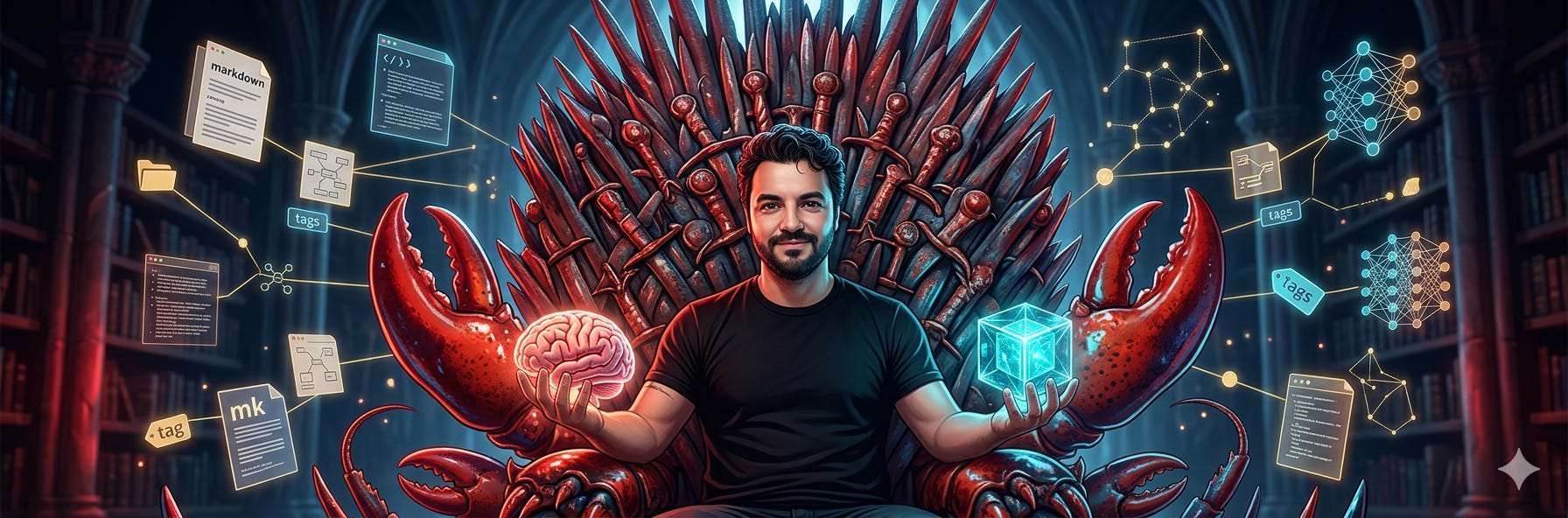
How I Built a Second Brain That Actually Works
The Death of Manual Organization: AI-Native Knowledge Management for 2026 and beyond
Table of Contents
This post was originally published on my Substack, The Physical Layer. Subscribe there for email updates.
I’ve tried building a “second brain” more times than I can remember. Notion, Obsidian, even good old folders and text files. Every time, same story: starts strong, gets messy, abandons ship after 3 months. Turns out I’m fundamentally terrible at manual organization and even worse at remembering to use systems I set up.
But here’s the thing: I wasn’t alone in this struggle. And more importantly, I now realize I was trying to solve this problem at the wrong time in history.
Why Your Brain Needs Backup (And It’s Not About Being Lazy) #
Here’s something I’ve come to understand: your brain wasn’t designed to be a storage system. For 500,000 years, humans have had the same cognitive architecture. We can hold about 4-7 things in working memory, we’re terrible at retrieval, but great at pattern recognition when patterns are in front of us.
Every time you force your brain to remember something instead of letting it think of something new, you’re paying a tax you don’t see. That tax shows up in relationships that cool off because you forgot what someone told you that mattered to them. It shows up in projects that fail in the same way you predicted at 11 PM three weeks ago, except you forgot to write it down. And it shows up as the background hum of constant open loops, that low-grade anxiety of “don’t forget to do this” running as a thread you can never close.
Writing itself is just a workaround for our brain limitations. So were filing cabinets, rolodexes, to-do lists. All attempts to extend our biological memory into something more reliable.
But 2026 Changes Everything #
Here’s what’s different about this moment in history: for the first time ever, we have access to systems that don’t just passively store information, but actively work on that information while we sleep. Systems that can classify, route, summarize, and surface without us having to remember to do any of those activities.
This isn’t an incremental improvement. This is an entirely new capability in the history of human cognition. And the most important part? You don’t need to be an engineer to build one.
My Breakthrough: Stop Taking Notes, Start Thinking Out Loud #
The breakthrough came when I stopped trying to be disciplined about note-taking and instead built an AI assistant that does all the boring work for me.
Here’s my setup: I have an AI assistant (🦞 + Opus 4.6) connected to Telegram. When I have a thought, meet someone interesting, or want to remember something for my second brain, I just share it in our conversation. Could be text, a photo of a wedding venue, a receipt, a random business idea, whatever.
The AI recognizes when something belongs in my knowledge base and automatically figures out what category it fits in (people, projects, ideas, admin). It creates properly formatted markdown files with YAML frontmatter, adds relevant metadata like dates and tags, files everything in my Obsidian vault using a customized PARA structure, and even handles the permissions so Resilio Sync works properly.
The vault syncs between my laptop and the server via Resilio Sync, so everything stays in sync without any cloud dependencies, although on my mac I save it inside a iCloud Drive folder, so that I can also access the vault from my phone.
The Game Changer: Contextual Retrieval #
The missing piece was making my knowledge base actually useful for conversations. The breakthrough came when my AI started reading my memory files and searching through my brain directory during our chats.
Now when I ask “who did I meet that was interested in robotics?” it scans through my people files, project notes, and memory entries to surface relevant context. It doesn’t just match keywords but reads the actual content and understands relationships between different pieces of information.
The AI has gotten remarkably good at connecting dots across months of captured thoughts, pulling together related ideas from different contexts, and even reminding me of things I’d completely forgotten I’d documented.
Why This Works When Traditional Systems Failed #
The key insight: the problem was never the note-taking app. The problem was expecting myself to consistently do boring manual work at exactly the wrong moments.
Traditional systems ask us to do cognitive work when we’re walking into a meeting, when we’re driving, when we’re about to go to bed. They ask us to choose folders and tags and structures when all we want is relief: to capture something and move on.
My brain wants to think, not file. So I optimized for capture speed and automated everything else. Voice message while walking? Bot transcribes and files it. Photo of a whiteboard? Bot extracts text and context. Random startup idea at 2am? Just text the bot.
The AI handles all the tedious stuff: formatting, categorization, tagging, linking. I just dump information and it becomes searchable knowledge automatically.
The Shift from Storage to Active Intelligence #
The shift from “AI that searches my notes” to “AI that maintains my memory” is exactly what I experienced. The difference is enormous.
Instead of having to explicitly manage a knowledge base, I just think out loud to my AI assistant. When something is worth remembering, it recognizes the context and handles the filing automatically. When I need to recall something, it pulls from that accumulated knowledge without me having to remember where I put it.
The system grows smarter over time as it learns my patterns and priorities. It starts suggesting connections I wouldn’t have made and reminding me of relevant context I’d forgotten. That’s the shift from building a storage system to having a thinking partner.
The Compound Effect #
What surprised me most is how it compounds. Every random thought I capture makes future conversations with the AI more valuable. It knows who I’ve met, what projects I’m working on, what ideas I’ve had.
Instead of starting every conversation from scratch, the AI can reference months of context. “Remember when you mentioned that robotics startup idea? Here’s how it connects to the DePIN thesis you wrote about last month.”
I went from having a graveyard of abandoned note-taking attempts to actually having a functional external brain. And the best part? Zero maintenance overhead. The system feeds itself.
Why Now is the Perfect Time for Everyone #
We’re at a unique moment where the barriers have dropped dramatically. You don’t need to be an engineer to build systems that used to require a principal engineer to implement. The tools are mature, the AI is reliable enough, and the principles are becoming clear.
Whether you build something like my setup (Telegram + OpenClaw + Obsidian + Resilio Sync) or use other tools, the core insight is the same: make capture effortless and let AI handle the organization. The human’s job becomes just thinking out loud, while the AI manages the memory.
For the first time in human history, we have access to systems that will work for us while we sleep. Systems that classify our thoughts without us deciding, that surface the right information without us searching, that nudge us toward goals we’ve set without us having to remember them.
Technical Details for the Nerds #
The system runs on OpenClaw, an agent framework I’ve customized with skills for knowledge management, memory search, and contextual filing. Telegram serves as the natural interface because it’s always in my pocket with zero friction for capture, and the conversation flow makes sharing thoughts effortless.
Storage happens in an Obsidian vault using a modified PARA methodology. The AI creates markdown files with proper YAML frontmatter, handles Unix permissions for group access, and maintains consistent folder structures. Resilio Sync provides peer-to-peer synchronization between my laptop and the bot’s computer, without any cloud dependencies.
The hardware is refreshingly simple: a compact Intel N100 mini PC with 16GB RAM and 480GB storage running Ubuntu. The N100’s four efficient cores handle everything from background crons to real-time conversation processing while sipping just enough power to run 24/7 without concern. It’s the kind of unassuming device that sits quietly on a shelf, costs pennies to operate, and just works.
Background crons handle periodic maintenance, news fetching and summaries, while the AI processes knowledge base content conversationally in real-time. The entire setup runs on hardware I already owned, with no vendor lock-in, no monthly subscriptions, and my data stays mine forever. Total running cost: maybe $3/month in electricity.
🧠 SECOND BRAIN STRUCTURE
═══════════════════════════════════════════════════════════

📂 brain/
├── 📥 inbox/           # Capture zone - raw thoughts & ideas
├── 👥 people/          # Relationships, contacts, follow-ups
├── 🎯 projects/        # Active initiatives & outcomes
├── 💡 ideas/           # Concepts, explorations, possibilities
├── ⚙️ admin/           # Tasks, finance, logistics, systems
├── 📖 journal/         # Time-based notes & experiences
├── 🔄 reviews/         # Weekly/monthly reflection cycles
├── 📋 templates/       # Structure blueprints for consistency
├── ✍️ substack/        # Writing & content development
├── 🔧 scripts/         # Automation & utility functions
└── 📎 attachments/     # Media & file storage

═══════════════════════════════════════════════════════════
        AI-POWERED KNOWLEDGE COMPOUND SYSTEM
═══════════════════════════════════════════════════════════

FLOW: Capture → Classify → Connect → Compound
INPUT: Everything goes to inbox/
ROUTE: AI sorts into semantic folders
STRUCTURE: Templates ensure consistency
REFLECT: Reviews create learning loops
OUTPUT: Connected intelligence over time

═══════════════════════════════════════════════════════════
Bottom Line #
If you’ve struggled with second brain systems like I did, maybe the solution isn’t better apps or more discipline. Maybe it’s accepting that humans are bad at manual organization and building systems that work with our lazy nature instead of against it.
The cost of not building this system isn’t just missed ideas. It’s that your work becomes less compounding. The value you create in 2026 is lower because you’re not building on previous insights as intentionally as you could be.
Sometimes the best productivity hack is admitting you’re not productive and automating around that fact. And in 2026, that automation is finally accessible to everyone, not just engineers.
The question isn’t whether you should build a second brain anymore. It’s whether you can afford not to, when the tools to make it actually work are finally here.
If you can’t figure it all by yourself, let me know and I would be happy to help!!
To infinity and beyond 🚀
If you found this interesting, I write about AI, hardware, and systems thinking on The Physical Layer. Come say hi.